Showing posts with label baby. Show all posts

Monday, February 18, 2013

Cute Aggression


Researchers found that people looking at a slideshow of cute animals popped more bubbles on bubble wrap vs. people watching funny/neutral pictures (120 bubbles for cute pictures, 100 for neutral pictures, 80 for funny pictures). Cuteness, in other words, cultivated aggression in people - not tenderness. Researchers don't yet understand why the nexus exists, but surmise it exhibits a loss of self-control.

Tuesday, June 12, 2012


Research finds that infants can be trained to improve their concentration skills.

For 15 days, 11-month-old infants were trained to focus on images on a computer screen. In one lab, a butterfly appeared as long as the infant focused on the butterfly and ignored distractions. An infant control group watched TV. Infants cognitive abilities were tested with toys at the beginning and end of the trial. Trained infants could focus for longer periods, better shift their attention from one point to another, and spot more patterns and smaller changes while playing with toys.


Sunday, April 15, 2012

Sleep More, Grow More


Research suggests that infants, male and female, who sleep more grow more and also gained weight and body fat. The extra growth may lead to erratic sleeping patterns as "growing pains" disturb the baby's sleep.

Tuesday, November 29, 2011

Baby Babble


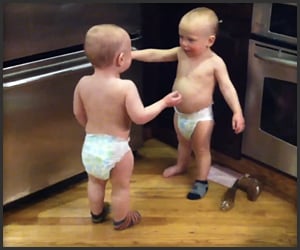
This video of twin babies "talking" has received 55 million+ views. But are they really talking? Probably not.

Babies normally babble by 10 months and use identifiable words by 14 months. Experts say the twins are engaging in “reduplicated babbling,” where they simply repeat a sound without knowing what is really going on.

But they are exhibiting a lot of the characteristics of normal speech (evidently from viewing others around them): taking turns babbling, imitating various speech intonations, emphatically ending sentences or exclamations, using gestures to supplement the babbling and body distance is "very appropriate for most Americans; not too close, but not too far either."

Saturday, August 20, 2011

Of Babies and Property Rights


Research investigated young children's understanding of property rights. 2 and 3-year-olds participated in situations where an actor (1) took an object for himself, and (2) attempted to throw it away. Sometimes the actor owned the object, sometimes the child, sometimes a 3rd party.

Results found that 2 and 3-year-olds protested frequently when their own object was involved, only 3-year-olds protested more when a third party's object was involved as compared with the object being the actor's. This suggests that by 3, children begin to understand property rights.

Sunday, December 19, 2010

Marketing to Toddlers


American food and beverage industries effectively spend $10+ billion/year in marketing to children.

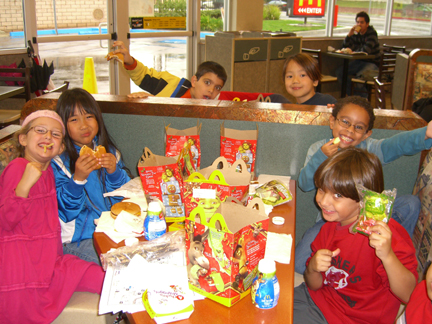
One study reveals that preschoolers were given the exact same food in unmarked or McDonald’s packaging. All the kids liked the marked packaging better - even if it was carrots. The effect may be observable in 2 year old's.

Thursday, November 11, 2010

Be Nice To Babies - They Can Tell


Research shows that infants can evaluate individuals based on their action toward others. Babies watched wooden shapes try to make it up a hill while other shapes would help or shove the other shape.

The babies were asked which shape they’d like to play with. Almost every baby reached for the shape that helped the circle rather than hindering it.

Here's a video of the study.

Baby Talk Crucial For Babies


Scientific American reports that adults must engage in silly baby talk ... so babies learn to talk like adults.

Mothers stretch vowels to make speech clearer which is especially attractive to infants and they turn their heads to the sound. They don’t with normal speech. By age 1, the infant brains starts to favor a specific language and ability to understand foreign languages declines while the brains of babies growing up learning two languages may stay open to new sounds longer.

Friday, March 12, 2010

Newborns May Cry in Mother Tongue


Research suggests that newborns cry in melodic patterns they have heard in adults’ conversations — even while in the womb. This means they are language learning even before birth.

Melodic patterns and pitch shifts attach emotion and meaning to words and newborns re-create those patterns in at least some of their crying. For example, in tests German newborns’ cries started out high-pitched and became increasingly lower vs. French newborns’ who started out low and moved higher - characteristic of how German and French is spoken. Also, prenatal babies prefer their mother's voice to others and days after birth discriminate between native and foreign languages.