Showing posts with label Biology. Show all posts

Monday, March 28, 2011

Freezing Fat to Death


Harvard researchers found kids who sucked on popsickles lost facial fat. Plastic surgeons reasoned if they could manipulate temperature and have people lose fat in other places. And they have been successful.

The procedure uses extreme cold to kill fat white cells while energizing brown fat (fat that helps burn calories). Overtime the fat white cells enters the stage of apoptosis - cell suicide.

Monday, February 21, 2011

Muscle Cramps? Drink Pickle Juice


For cramps to occur, certain mechanisms within muscles start misfiring when a muscle is fatigued, causing muscles to bunch together when it should relax. So how do we stop it?

In a study, athletes conducted a variety of exercises and then cramps were electrically stimulated in their big toe. Volunteers were told to relax and cramps lasted for ~2.5 minutes. The volunteers did not drink any fluids.

Then cramps were again stimulated, but athletes immediately drank 2.5 ounces of deionized water or pickle juice. Within 85 seconds, the men drinking pickle juice stopped cramping. But cramps continued in men drinking water. Pickle juice stopped a cramp 45% faster than drinking no fluids and 37% faster than water.

While the mechanism is unclear, the key ingredient is vinegar as another study showed drinking pure vinegar was more effective than drinking pickle juice.

Friday, January 14, 2011

Steroids Lingering Effects


Research found that even years after abstaining from steroid use — and little or no weight training — muscle fiber density and increased number of cell nuclei were comparable to drug-free athletes performing high-intensity strength-training. Additional cell nuclei could help former dopers because more nuclei = more protein synthesis = more muscle.

Saturday, November 27, 2010

Chill Out Pre-Workout


50 athletes were placed into a cooling chamber at -120 degrees for 2.5 minutes. They then ran at 90% of their max. After six months, the cooled athletes showed much better results and an increased oxygen carrying capacity.

Scientists think the chilling 1) slows the rise of body temperate, which harms performance; 2) conserves body fluids, because athletes sweat less.

Sunday, November 21, 2010

Bad Smells Are Good


Scientists used to think odors directly activate the trigeminal nerve - which responds to touch, temperature and painful stimulation in the head, and extends to the nose. New research suggests that specialized chemosensory cells lining the nasal cavity first detect smells and pass the news to the trigeminal nerve, alerting the brain.

Having these special sensory cells as a medium might make our noses sensitive to a variety of odors which helps us avoid bad stuff.

Gator's Lungs Help in Locomotion


Research shows that alligator's can effortlessly glide through the water because they shift the location of their lungs. Lungs act like flotation devices which a gator uses to steer just by moving them around. Surfacing means moving lungs forward; diving requires pushing lungs back; changing direction means moving them to one side or another.

Bacteria That Eat Antibiotics


Research shows that certain soil bacteria feeds on antibiotics. This might be surprising but recall that most antibiotics come from organisms that live in the dirt so some bacteria are bound to adapt.

Friday, November 19, 2010

Full Fat Ice Cream Improves Fertility


A study of 18,000+ women aged 24-42 reveals that women who ate full-fat milk or ice cream increases chances of ovulating. Also, the more you eat, the more likely you ovulate (if your overall calorie intake remains the same). In contrast, those eating at least two servings of low-fat milk products/day were 85% more likely to have problems ovulating than women who only ate one serving.

Thursday, November 18, 2010

Take A Nap - Its Healthy


Research shows that naps reduced the risk of coronary mortality by 1/3rd. ~24,000 Greeks were studied for 6+ years - none had cardiovascular disease at the study's start. Those taking at least 3 midday naps/week of at least 1/2 hour each had 37% lower risk of coronary-related death. The effect was more among working men, retirees got less of a benefit.

So next time your boss finds you sleeping at work, tell him you're taking care of your health.

Saturday, September 25, 2010

Your Home's Height Affects Your Age


National Geographic reports that you'll age slightly faster on a higher altitude.

It's because of the time-bending effects of the theories of relativity. Special relativity predicts time flows at an unsteady rate and also says that acceleration affects time. So, a clock speeding away from an observer will appear to tick slower than a stationary clock. Relativity also predicts that gravity also affects time - the stronger the gravity, the slower the time. Gravitation pull on an object increases closer to the center of mass, so an object on Earth's surface experiences a slightly stronger pull than one floating in the atmosphere.

But don't go buying homes underground. Over a 79-year lifetime, you'd only add ~90 billionths of one second to your life if you moved to lower ground.

Sunday, August 22, 2010

More Zombies In Nature


I previously blogged about real cases of zombies in nature. There's at least one I missed.


A parasitic fungus (Ophiocordyceps unilateralis) infects a carpenter ant and takes over its brain, leading the ant to bite into the vein that runs down the center of a leaf on the underside. The ant dies but the fungus takes the nutrients to grow a stalk out of the ant’s body and release spores to create the next generation. This cycle is at least 48 million years old.

Tuesday, August 17, 2010

Raven Defies Natural Selection


National Geographic presents an experiment in which a raven is put on a branch while its food is hung from a string. Researchers wanted to see if the raven could think through the process and pull the string up to itself to obtain the food.

It did.

The problem is that:

1) The behavior was not learned as the researchers did not teach the raven the skill
2) Natural Selection does not provide the answer as the scenario would not have occurred in the wild
3) Chance could not provide the answer because there were too many individual steps

Thus, the ability to actively think through solving this problem must be an innate quality. But for a bird without a cerebral cortex - instrumental in creative thought - to perform such a function is nothing short of magical.

Aesop's Fable - A Reality


Aesop tells the story of a thirsty crow who comes upon a pitcher with water that is beyond its reach. The crow uses pebbles to raise the water level and gets his drink. It was just a fable ... until last year.

Current Biology reports that 4 captive rooks (similar to a crow) were forced to decide how to raise the water level so that a floating worm was reachable. All 4 rooks solved the problem with precisely the number of stones needed. 3 rapidly learned to use large stones over small ones and understood that sawdust cannot be manipulated in the same manner as water.

The discovery is mind-blowing. It furthers the notion that tool usage is a flexible ability in animals, and holds implications for the evolution of tool use and animal cognition. It also demonstrates certain animals' ability to solve complex physical problems via causal and analogical reasoning. For the rook to do this without a cerebral cortex - instrumental for creative thought - leaves one in awe.

See video #1 & #2 of the study

Tuesday, June 29, 2010

What Did Craig Venter Do?


Using an existing cell, J.Craig Venter and his team incorporated the chemically synthesized genome of one bacteria into another. Thus, Venter basically created the first DNA of a living cell. This bacterial cell is the first life form to have synthetic DNA entirely control it. It is a key step towards the design and creation of new living things.

The team hopes to "build" bacteria that absorb carbon dioxide to help repair the environment.

Here's a clip of the breakthrough.

Monday, March 8, 2010

Why Do We Hiccup?


Breathing requires help from the diaphragm, a large muscle between the chest and abdomen. Phrenic nerves control the diaphragm and nerve irritation induces a spasm, forcing short, quick breath's between closing of the epiglottis (a flap that protects the space between the vocal cords). The epiglottis' closing creates the 'hiccup'. A full stomach (food or air), too much spicy food, smoking, alcohol, sudden emotional swings, or sudden temperature shifts can all irritate the phrenic nerves, causing a hiccup.

To stop a hiccup, bite into a lemon, pull on your tongue, or hold your breath ... something Charles Osborne should have done. Osborne is in the Guinness Book of World Records title for Longest Hiccup Attack, hiccuping for 68 years (1922-1990).

This guy could have used the help as well.

Tuesday, February 23, 2010

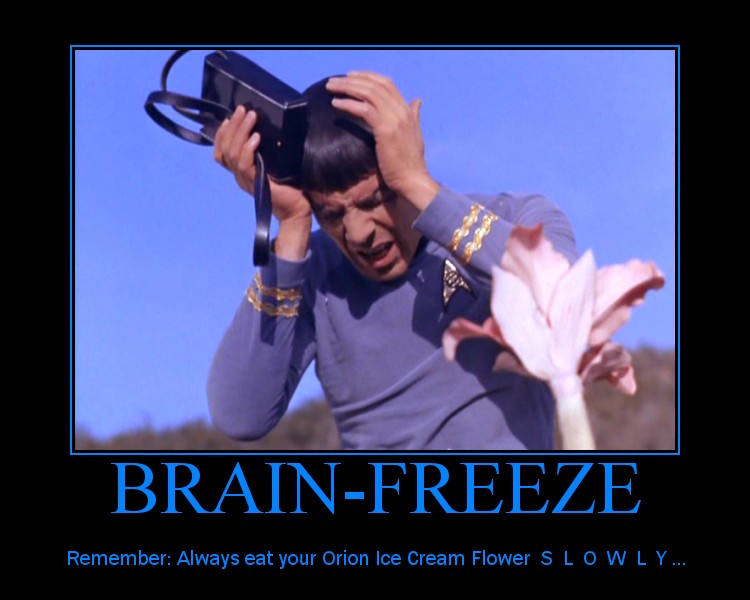
What is, and how to stop, a Brain Freeze


The esteemed British Medical Journal published an editorial on the science behind brain freezes. Good news: you don't have to give up ice cream.

The most common cause of head pain is ice cream - occurring in 1/3rd of a randomly selected population. When something cold touches the roof of your mouth, blood vessels in your head dilate. The dilation may be due to contact with a nerve center in the roof of your mouth.

Whatever the case, if you want to avoid brain freezes don't give up ice cream or cold drinks. Instead, just avoid having anything cold touch the roof of your mouth.

Saturday, January 16, 2010

Want Tastier Food? Add Calcium


Aside from molecules that trigger specific taste buds (salty, sweet), other substances have no flavor of their own but enhance flavors they are paired with - known as "kokumi" taste. Calcium is now believed to be a kukomi element.

Calcium, as well as calcium channels (which sense and regulate calcium levels), on the tongue are the targets of compounds that can enhance taste.

Calcium channels are closely related to the receptors that sense base flavors and kukomi ingredients are enhanced when they interact with calcium channels. During tests, those molecules that induced the highest activity in calcium receptors also elicited the strongest flavor enhancement. Moreover, blocking calcium channels reduced flavor experience.

Maybe mom was on to something when she made sure you finished your milk!

Wednesday, January 6, 2010

Ants that Farm


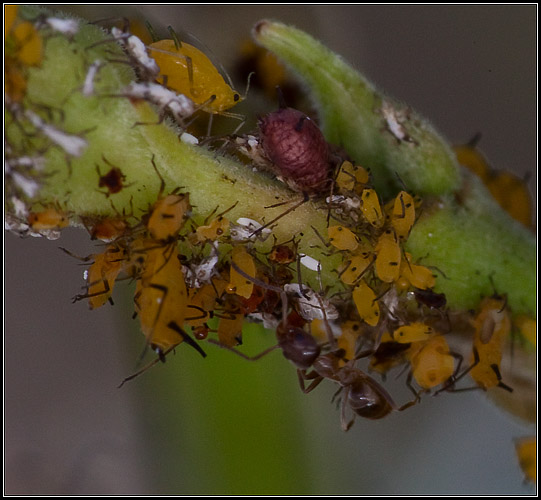
Much like humans herd cows, ants farm aphids which manufacture sweet honeydew nectar. The ants force the aphid to secrete the nectar and eat it themselves. Ants even move aphids to plants where more nectar can be found, much like a farmer moves his herd to greener pasture.


Check out the video.

Friday, January 1, 2010

Quit Smoking - Save Your Vision


A UCLA study reveals that smoking increases risk for age-related macular degeneration (AMD), the leading cause of blindness in Americans over 65. AMD damages the macula, the retina's center allowing us to see fine details. Cigarette smoking may increase AMD risk by reducing serum antioxidant levels, altering blood flow to the eyes and decreasing retinal pigments.


The effect is significant, even for individuals over 80 years of age ... so it really is never too late to quit.

Monday, December 28, 2009

Radition - Cause of Gray Hair


Melanocyte stem cells exist within every hair follicle. These cells gradually split into two populations - 1 produces pigment for hair before dying, while the other becomes a new melanocyte stem cell. In a perfect world, these cells would replenish themselves indefinitely and we'd keep our original hair color (baldness notwithstanding).

Researchers think the melanocyte die-off may allow the body to shed potentially cancerous, radiation-stressed cells. Emotional Stress as a harm to stem cells is still up in the air - so don't blame your spouse just yet.