Showing posts with label sound. Show all posts

Friday, June 8, 2012

Metallica and Monkeys


A study revealed that cottontop tamarins listened to a variety of music (Bach, Led Zeppelin, Miles Davis, etc.) but only calmed down when listening to Metallica.

Like in music, in human speech, changing the tone of one's voice, the rhythm, pitch or speed allows one to gauge the emotional state of the speaker. For example, we use long tones for calming a baby while using short tones to indicate seriousness. The study found that monkeys, "interpret rising and falling tones differently than humans."

Tuesday, May 15, 2012

Loudest Animal


The water boatman insect makes the loudest sound for its body size ... its 2 mm long but its chirp registers at 99 decibels - the same as that of a snowmobile.

Tuesday, December 20, 2011

Noise = Stroke for Elderly?


For people over 65, research finds a 27% increase for risk of stroke for every 10-decibel increase in street noise.

Researchers studied 51,000+ Danish city dwellers for ~10 years. The study, however, doesn't categorically prove road noise causes strokes. But studies have linked noise to heart attacks and higher blood pressure — possibly because of increased stress and less sleep.

Friday, November 11, 2011

Brain Can Hear by Seeing


Research suggests the brain actually links hearing with sight because simply seeing a vase shatter activates the brain's auditory areas. In other words, you can "hear" even when you only "see" the sound being produced. MRI scans of silent videos of things being broken or instruments being played revealed activation of the auditory cortex and categorization of the sound.

Wednesday, September 7, 2011

All Animals Sound the Same


Researchers
compared the calls of 500 different animals - insects, mammals, reptiles, fish - you name it. They found that the basic features of every animal’s cry (e.g. frequency, duration) depend on the animal’s metabolism, which depends on the animal’s size and body temperature.

When the calls account for body size and temperature, a whale sounds a lot like a frog and vice versa. Researchers think a metabolic link exists, because energy use affects the nerves and muscles animals use to make noise.

Saturday, July 9, 2011

Sound During Sleep Improves Learning


Research finds that sleeping after learning helped retain new information, especially if sound cues related to the information were played during sleep.

Subjects learned the positions of 50 objects on a computer screen - each picture paired with a unique sound. During sleep, scientists played the sound cues for half the images presented during the memory test. Subjects were better at placing the objects for which sound was played during sleep, even though none reported hearing anything.

Monday, May 30, 2011

Pigeons Whistle for Safety


Research reveals that pigeon wing-flapping creates distinct whistles, warning flock-mates when taking off or when escaping predators. Scientists recorded the sounds crested pigeons wings made during a routine liftoff and during an emergency takeoff. The sound produced during dangerous moments includes a distinctive whistle. That noise scatters a flock of pigeons as quick as the shadow of a predator.

Saturday, March 12, 2011

Hair Allows Hearing


Scientists discovered that our hearing is because our ears have tiny tubelike motors that mechanically amplify sounds.

Hair cells in your ears have spiky hairs like molecular mohawks. When sound waves enter the ear these hairs vibrate, and your brain computes it as sound. But these hairs don't move like grass in the breeze. The electrical signals the hairs produce feed back on the system, causing the hairs to tilt even more - called the “flexoelectric effect."

Hair length in different species explains why animals like bats can detect such high frequency sounds.

Monday, January 24, 2011

Levitation With Sound


Liquid droplets, while useful for research, are easily contaminated by other liquids or surfaces. In response, scientists are making liquids bounce or float in air. Droplets on oil's surface eventually collapse but employing sound vibrations makes droplets lightly bounce, thereby separating the droplets from the oil.

Here's a video of ultrasonic levitation.

Thursday, December 30, 2010

Loud Bar = More Beer


Research found that when bar music was louder, alcohol consumption rose.

Researchers think 1) loud music may energize and excite bar-hoppers, encouraging binging; or 2) it was too loud to talk, so people focused more on drinking.

Wednesday, December 22, 2010

Bad Singing


Researchers randomly asked people to sing Quebec’s anthem. 40 out of 42 people sounded as good as the pros.

But why couldn’t the 2 bad singers carry a tune?

Repeating the experiment, researchers asked people to sing Jingle Bells and then tested their ability to listen to some music and identify bad notes. They found that bad singers either cannot recognize the wrong notes ... or simply do not care how they sound.

Monday, November 29, 2010

Music Sounds Different To Different People


Researchers placed auditory implants in ferrets and each ferret responded differently to the same sound because neurons reacted differently each time, an effect applicable to humans. So, human brains process sounds depending on how our ears deliver that sound. This means different people may hear the same sound differently.

Still, this is music no matter what anyone says.

Tuesday, November 23, 2010

Snakes Hear With Jaws


We know that snakes see heat with their noses and smell with their tongues. Now, we know they hear with their jaws.

Snakes only have an inner ear system. The cochlea - instrumental in hearing - is connected to the snake's jawbone. Vibrations that move a snake's jaw, therefore, allow the snake to hear ... even as minute as that of a rodent. Because snakes can unhinge their jaws one side at a time, they may be able to hear in stereo.

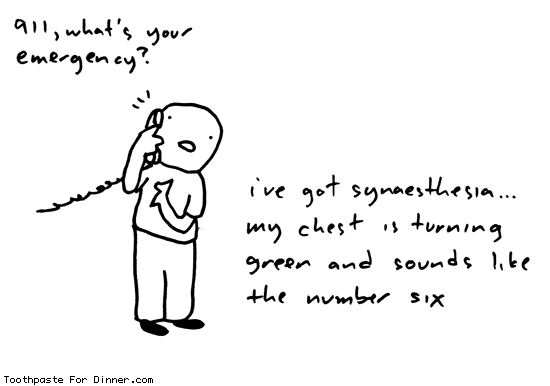
Smelling Sounds, Hearing Colors


Humans can hear colors and smell sounds. Its called synaesthesia and affects ~1 in 1,000 people - most not knowing they have the condition.

"There are people for whom time units evoke colors ... It is also common for a synaesthete to see colors when listening to words, sounds in general or music notes (people who can see music, for instance). There are also cases, although fewer, where people can see colors in flavors, others perceive flavors or experience touch sensations when listening to different sounds, some link flavors to touch sensations, etc."

“Smounds”— We Detect Half Sound, Half Smell


Food smell could be related to the sounds we hear while eating.

Scientists studied the increased activity of mice's olfactory tubercle - a brain structure aiding in odor detection - when making a rattling sound. When clanking a mug, 65% of tubercle cells were activated. A tone only registered 19% activity. Scientists repeatedly sent a mix of odors and tones into tubercle cells. They noted 29% became enhanced or suppressed depending on the presence/absence of the second stimulus.

Thursday, October 21, 2010

Sound Affects Taste


Food Quality and Preference reports that sound can affect our perception of taste.

College students were given headphones playing loud white noise, soft white noise, or nothing. They then closed their eyes and ate snack foods. Loud noise listeners rated chips less salty, cookies less sweet and crunchy foods crunchier VS. those who ate the same foods with less/no noise.

Studies show that sound can interfere with how the brain processes smell; maybe the same is true for taste.

Sunday, July 19, 2009

Density and Sound

Ever wonder why your voice sounds lighter when inhaling helium? It is because sound waves speed is dependent upon the medium through which it is moving.

Through 'air' at sea level, sound moves at ~770 mph. When you change the density of the medium, the sound wave will most faster or slower.

Helium is ~6 times less dense than air; i.e. sound will move 6 times faster through it, translating to a higher pitch.

In contrast, something like sulfur hexafluoride is ~6 times denser than air and the exact opposite effect will happen.

See for yourself.