Showing posts with label smell. Show all posts
Saturday, November 3, 2012
The Scent That Makes You Smarter
A study shows that smelling rosemary can improve cognition.
20 participants were exposed to varying amounts of rosemary while doing subtraction and visual processing tasks. Rosemary oil didn't increase attentiveness, but those exposed to more rosemary did their tasks faster and better. The key component - 1,8-cineole - is also found in eucalyptus and sage essential oils.
Saturday, July 9, 2011
Clean Smell Promotes Morality
A study finds that people sprayed with citrus-scented cleanser were fairer and more generous than otherwise. Scientists first evaluated fairness and discovered clean-smelling room subjects offered twice as much cash with a stranger in another room. In the second test, clean-smelling room participants were significantly more interested in volunteering and almost three times more likely to donate money.
Katie Liljenquist, lead author of the study, notes, "There is a strong link between moral and physical purity that people associate at a core level."
Labels:
morality and science,
psychology,
smell,
social behavior
Monday, January 24, 2011
Body Odor "Fingerprints"
Research suggests that each mammal, including humans, has a unique body odor type. All mammals have specific genetically-determined smells (odor types), meaning our odor-print may be as individual as our fingerprint. So devices could be built to detect unique odor-prints ... which is bad news for criminals.
Tuesday, November 23, 2010
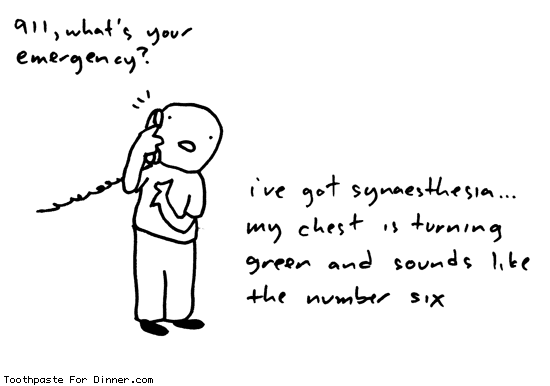
Smelling Sounds, Hearing Colors
Humans can hear colors and smell sounds. Its called synaesthesia and affects ~1 in 1,000 people - most not knowing they have the condition.
"There are people for whom time units evoke colors ... It is also common for a synaesthete to see colors when listening to words, sounds in general or music notes (people who can see music, for instance). There are also cases, although fewer, where people can see colors in flavors, others perceive flavors or experience touch sensations when listening to different sounds, some link flavors to touch sensations, etc."
“Smounds”— We Detect Half Sound, Half Smell
Food smell could be related to the sounds we hear while eating.
Scientists studied the increased activity of mice's olfactory tubercle - a brain structure aiding in odor detection - when making a rattling sound. When clanking a mug, 65% of tubercle cells were activated. A tone only registered 19% activity. Scientists repeatedly sent a mix of odors and tones into tubercle cells. They noted 29% became enhanced or suppressed depending on the presence/absence of the second stimulus.
Subscribe to:
Comments (Atom)