Showing posts with label Chemistry. Show all posts

Tuesday, July 5, 2011

Fizz has Taste


Scientists have discovered that carbonation actually has a flavor and gene manipulation can render an animal "blind" to the taste of carbonation. Scientists think our CO2 sensor evolved to help us avoid food that’s spoiled but we still enjoy fizz that tickles our tongue.

Monday, May 30, 2011

Champagne like Ocean


Researchers found surfactant (molecular compounds) concentrations higher at the surface of a glass of champagne than in the champagne itself.

In ocean air, surfactants are dragged along with bubbles in ocean waves. When bubbles burst, the surfactants break into aerosols that give ocean air its odor. A champagne glass is a small "ocean," but the bubbles bring more pleasing aerosols to the surface.

Wednesday, December 22, 2010

Cleaning Oil Spills


~200,000 tons of oil have polluted waters around the world from 2000=2010 alone. In response, researchers have designed nanowires of potassium manganese oxide that feels like paper. Tiny pores between the wires absorb oil (up to 20 times its weight) but repel water. It can also be reused because potassium manganese oxide is stable at high temperatures. This means one simply heats the nanowires above oil's boiling point so the oil evaporates while the paper is clean ... and the oceans

Saturday, October 16, 2010

Drugs - Why People Do It


Despite the consequences, legal and health-related, drug consumption is on the rise. One may ask how enjoyable the experience must be to offset the inevitable dangers. The key is the neurotransmitter dopamine. Dopamine release occurs in all pleasurable experiences.

National Geographic explains what goes on in the brain when smoking crystal meth.

BBC explains what goes on in the brain when smoking marijuna.

This amateur video explains in detail what goes on during a cocaine high.

Monday, July 26, 2010

The Mona Lisa: Secret Revealed


Leonardo da Vinci is revered for his ability to blend tones and colors without any visible brushstroke. His famed technique of sfumato gave the painting a hazy quality and an illusion of depth and shadow. No consensus has been reached on how Da Vinci generated this effect ... until now.

Using X-ray fluorescence spectroscopy, results prove that Da Vinci was an experimental artist with an unbelievably dextrous hand. In the Mona Lisa, Da Vinci overlayed four separate layers of paint and included several sub-layers of glaze – with different thicknesses and varying amounts of added pigments including manganese oxide.

The Mona Lisa's paint layer thickness ranges from 1-2µm - 40µm. Note: a red blood cell's diameter is 8µm; a human hair is 100µm thick.

Tuesday, April 13, 2010

Elastic Water


Nature published a report on a cool new material comprised of 95% water and some clay and organic material. The result is "elastic water" (EW), an extremely elastic and transparent jelly-like substance.

EW was produced in light of emphasis on reducing dependency on fossil-fuel energy. EW could be used to create plastics without the use of petroleum while having the ability to mould into shape-persistent, free-standing objects. It also preserves biologically active proteins for catalysis, meaning it could help wounded tissue to remain closed.

Thursday, September 10, 2009

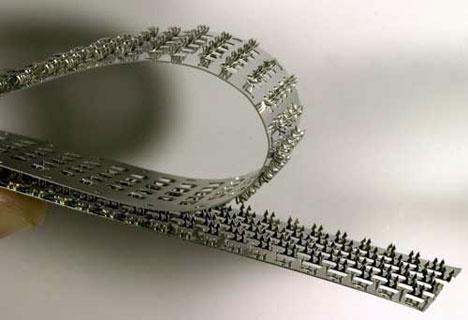
Super Velcro


Engineers have developed a velcro-style material out of steel. The material works just like normal velcro, except it can tolerate high temperature (800° C), tensile loads up to 35 metric tons/m2, and exposure to strong chemicals.

The velcro will be useful in automotive systems (near exhaust pipes where heat and corrosive gases are prevalent), to snap aluminum siding onto homes, or to attach hospital curtains where strong chemicals regularly sterilize fasteners.

The inspiration for this new age velcro? The age old burrs that get stuck in your clothes.

Wednesday, September 9, 2009

Night Vision Without Goggles


Unlike other deep-sea fish, the dragonfish can perceive red light due to the generation of chlorophyll. Research at Columbia University discovered that chlorophyll administered to the eyes in other animals doubled the animals capacity to see in low night.

The D.O.D is now investing in research to allow for the same in humans to be used on the battlefield.

Sunday, July 26, 2009

Glowing in the Dark


Everyone has seen glow sticks or glow-in-the-dark stickers and posters or even lightning bugs. But did you know there are more than 50 species of plants and animals that glow?

Various jellyfish exhibit a phenomenon known as 'bioluminescence' - essentially glowing in various colors - as a means of defense. Plankton known as dinoflagelletes will emit light when threatened in order to attract larger predators that will eat the dinoflagelletes predator. Bioluminescence also occurs in railroad worms, pinecone fish, ping pong trees, and octopus. In bioluminescence, chemical energy is converted to light energy through an enzyme-catalyzed chemoluminescence reaction'. This means luciferase oxidizes the 'pigment luciferin (oxidation is the same process that is responsible for the rusting of metals through the loss of one or more electrons). Here's another video of various animals that glow through the process of bioluminescence.

Others, such as comb jellyfish, produce a rainbow through a different process of scattering light across it's moving 'combs' (cilia, or tails, which help in locomotion).

Amongst animals, the phenomenon is believed to 1) help frighten off predators when the animal feels threatened, 2) to camouflage the animal by blending with the surrounding levels of light, 3) or even to attract prey or a mate.

Plant life such as mushrooms and fungus are believed to have this quality to help attract pollinators.