Showing posts with label time. Show all posts

Monday, October 24, 2011

Altruism Takes Time


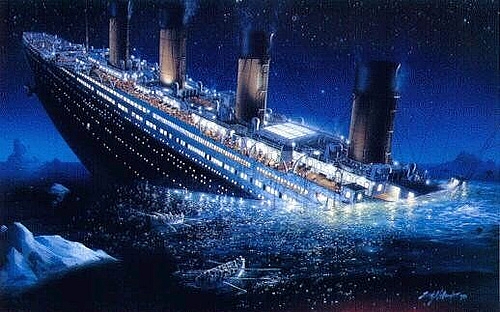
Research of the survival rates of men, woman and children from the Titanic and the Lusitania revealed that more men survived when the ship sunk fast - i.e. time is controlling.

The Titanic took ~3 hours to sink - survivors were mostly female or children. On the Lusitania, which sank in 18 minutes from a German torpedo, survival of the fittest kicked in and healthy young males mostly survived. Panick controlled the Lusitania while planning and chivalry controlled the Titanic's passengers.

Thursday, October 13, 2011

Take Your Time in Gunfight


Research finds that reacting to a movement (e.g. being drawn on in a gunfight) is faster than the initiating movement. In other words, the person who is drawn on (not the one who draws the gun) reacts quicker.

Gunfighter 2 can be 10% faster reacting than if the same person drew his gun first (~21 milliseconds faster than gunfighter 1). Still, unless gunfighter 2 is a better shot, he will probably die because while #2 moves ~21 milliseconds faster than #1, the initiation of #2's movement is ~200 milliseconds.

Monday, August 8, 2011

Faster = Funner


Instead of "Time flies when you’re having fun," research indicates that when you're having fun, time flies.

In a 10-minute test, “time’s up” was called when only five minutes had passed. The other half worked for 20 minutes before their 10-minute test was done. Results found that the 5 minute team said they had more fun.

Wednesday, February 16, 2011

Time-Stamped Brain Cells


Research reveals that new neurons in the hippocampus are time stamped - i.e. simultaneous events are permanently linked in our minds. New neurons develop daily in the hippocampus - a key area of the brain responsible for memory formation. These neurons are hyperactive early on to absorb all the events going on around them and temper off activity over time. This is, for example, why you probably know the sights and sounds of when you proposed to your spouse.

Thursday, November 18, 2010

Lifestyle Affects Internal Body Clock


Research shows that despite living in the same time zone, body clock's of people living in the country are closely attuned to time based on the sun's position VS. city folk's internal clocks which social cues (e.g. engagements) greatly affect.

Saturday, September 25, 2010

Your Home's Height Affects Your Age


National Geographic reports that you'll age slightly faster on a higher altitude.

It's because of the time-bending effects of the theories of relativity. Special relativity predicts time flows at an unsteady rate and also says that acceleration affects time. So, a clock speeding away from an observer will appear to tick slower than a stationary clock. Relativity also predicts that gravity also affects time - the stronger the gravity, the slower the time. Gravitation pull on an object increases closer to the center of mass, so an object on Earth's surface experiences a slightly stronger pull than one floating in the atmosphere.

But don't go buying homes underground. Over a 79-year lifetime, you'd only add ~90 billionths of one second to your life if you moved to lower ground.

Tuesday, September 14, 2010

Duration Affects Purchases


Nature Neuroscience
reports that when deciding between two snacks on the shelf, you will probably choose the one you look at just a fraction of a second longer.

In one study, students fasted for three hours, before rating the tastiness of snack foods and then chose between snack foods they had rated as more or less equally desirable. Researchers tracked the student’s eye movements.

Students looked back and forth several times, usually glancing first at the snack on the left. 70% of the time they selected the snack they looked at for .5 seconds longer.

Tuesday, February 2, 2010

Time Travelling - Sort of


Research indicates that man's perceptions of space and time is interwoven. Researchers found that the mere act of thinking about the past or future caused test subjects to move backward or forward.

Monday, December 21, 2009

More Fun = Less Time (Sort of)


Time flies when you're having fun, but now the opposite may also be true. Psychological Science has published a study arguing that if people believe time has past quickly, they think they had more fun.