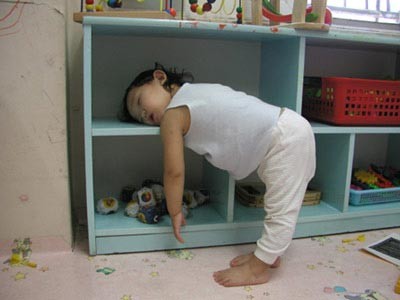
Children don't just affect a mother's attitude - they actually change a mother's brain. See the video.
Showing posts with label neurobiology. Show all posts
Friday, September 23, 2011
Kids Change Mothers Brain
Children don't just affect a mother's attitude - they actually change a mother's brain. See the video.
Thursday, August 18, 2011
Fitter = Smarter
Research suggests that adolescent physically fit men tend to be more intelligent than their non-athletic counterparts.
Animal studies have long shown a link between physical activity and better memory. In humans, aerobic exercise can boost cognitive function in old people. Scientists found that of 1+ million men enlisted for military service @ 18, cardiovascular fitness, not muscle strength, was associated with overall intelligence (in the Swedish army). Physical fitness at 18 also foreshadowed greater academic achievement later in life for the public in general. Even among the twin pairs, the fitter brother tended to be the smarter.
Monday, May 16, 2011
Lower Teen Crashes By Sleepign In
High schools in Virginia Beach, VA start 75-80 minutes earlier than high schools in neighboring Chesapeake (w/ similar demographics). Research found Virginia Beach crash rates were significantly higher and peak crash times were one hour earlier than peak Chesapeake crash times.
A previous post highlighted the benefit of starting school late, to afford for teens sleeping needs.
Think Powerful - Be Powerful
Humans express power through open, expansive postures and express powerlessness through closed, contractive postures. Researchers asked if these postures actually create power? Studies revealed that high power nonverbal displays (vs low-power nonverbal displays) cause neuroendocrine and behavioral changes.
High-power posers elevated testosterone levels, decreased cortisol levels, and increased feelings of power and tolerance for risk (low-power posers exhibited the opposite). High-power displays caused "advantaged and adaptive psychological, physiological, and behavioral changes" suggesting "embodiment extends beyond mere thinking and feeling, to physiology and subsequent behavioral choices."
The research corroborates Mirza Ghulam Ahmad's ground breaking 1896 treatise of the relationship between body, mind and soul.
Labels:
mirza ghulam ahmad,
neurobiology,
neuroscience,
psychology,
soul,
will power
Monday, March 21, 2011
Eyes Do Math

Researchers scanned brain activity of people moving their eyes right or left and asked participants to do mental math. They found that the brain circuitry that moves the eyes right does mental addition and the circuitry moving eyes left does mental subtraction. The finding demonstrates that math's development is too recent and advanced to have a brain region solely devoted to it - we reuse preexisting systems.
Wednesday, February 16, 2011
Time-Stamped Brain Cells
Research reveals that new neurons in the hippocampus are time stamped - i.e. simultaneous events are permanently linked in our minds. New neurons develop daily in the hippocampus - a key area of the brain responsible for memory formation. These neurons are hyperactive early on to absorb all the events going on around them and temper off activity over time. This is, for example, why you probably know the sights and sounds of when you proposed to your spouse.
Friday, January 14, 2011
Brain Is An Active Listener
Language is delivered at up to 5 syllables/second so scientists thought listeners kept pace by anticipating a subset of words the listener knew (like how Google Instant works). Functional MRI's show the brain considers different words and narrows choices by considering words beginning with the same sound.
For example, if one says, “I tasted the sweetest can…" your brain might be priming itself to hear "candy" or "cantaloupe", but not "candle."
Labels:
active listening,
hearing,
MRI,
neurobiology,
neuroscience
Wednesday, December 8, 2010
Tetris Good For Brain
Prolonged Tetris exposure can lead to more efficient brain activity as energy consumption decreases (measured by glucose consumption) - meaning the brain is operating more efficiently. 1/2 hr/day for 3 months can increase "critical thinking, reasoning, language and processing" and increase cerebral cortex thickness.
Thursday, November 18, 2010
Lifestyle Affects Internal Body Clock
Research shows that despite living in the same time zone, body clock's of people living in the country are closely attuned to time based on the sun's position VS. city folk's internal clocks which social cues (e.g. engagements) greatly affect.
Thursday, November 11, 2010
Baby Talk Crucial For Babies
Scientific American reports that adults must engage in silly baby talk ... so babies learn to talk like adults.
Mothers stretch vowels to make speech clearer which is especially attractive to infants and they turn their heads to the sound. They don’t with normal speech. By age 1, the infant brains starts to favor a specific language and ability to understand foreign languages declines while the brains of babies growing up learning two languages may stay open to new sounds longer.
Thursday, October 21, 2010
Sound Affects Taste
Food Quality and Preference reports that sound can affect our perception of taste.
College students were given headphones playing loud white noise, soft white noise, or nothing. They then closed their eyes and ate snack foods. Loud noise listeners rated chips less salty, cookies less sweet and crunchy foods crunchier VS. those who ate the same foods with less/no noise.
Studies show that sound can interfere with how the brain processes smell; maybe the same is true for taste.
Friday, September 24, 2010
Why Do We Eat Chili's?
Chili's get their heat from capsaicin, an organic compound that fights off a fungus that attacks chili seeds. More capsaicin is produced in chili's where the fungus is more likely to grow, and little where the fungus is not a danger. Aside from humans, no other mammal eats these beasts. But if they're so spicy, why do we eat chili's?
Some push the health card b/c chili's: help lower blood pressure, may have antimicrobial effects, and the pain of chilies can neutralize other pain. Dr. Paul Rozin argues that the beneficial effects are too small to explain why. What's his proposition?
Benign masochism.
Dr. Rozin tested chili eaters by gradually increasing the pain (pungency) of the food. Participants all preferred the level closest to unbearable. He says we eat chili's for the same reason we ride roller coasters - for the thrill. He says only humans enjoy events that produce feelings we are programmed to avoid.
Whatever the case, it still doesn't explain this woman who eats jolokia peppers (hottest in the world) like candy, even rubbing it in her eyes.
Labels:
chili,
mind,
neurobiology,
pepper,
pleasure seeking,
psychology
Tuesday, July 6, 2010
World Cup Science
Rensselaer Polytechnic Institute scientists have discovered how a kicker’s body can reveal where he’s aiming.
In a penalty shot, the ball can touch net in about half a second - faster than a keeper can go from the goal’s center to either post ... meaning the goalkeeper must move before the kicker’s foot meets the ball AND correctly guess the direction.
The angle of the kicker’s hips and the way he plants his supporting foot are the most telling factors.
Want To Improve Grades? Sleep In
The Archives of Pediatrics and Adolescent Medicine has conducted a study that argues students grades can improve if school started a 1/2 hour later than it currently does.
From adolescence, children have a delayed sleep phase - they sleep later and need about 9.25 total hours of sleep.
One test case in Rhode Island revealed that after the delayed start: students who got at least eight hours of sleep went from 16% to 55%, attendance improved, there were fewer visits to the health center for fatigue-related complaints and far less students said they felt unhappy, depressed, annoyed or irritated.
Friday, May 14, 2010
Really Smart Cobras
Spitting cobras attack tactics presented a challenge to researchers. The cobras strikes are extremely accurate and each strike is unique. This is puzzling because the cobra's fangs are fixed so pattern of the fluid should be fixed. Also, the snakes 'wiggled' their heads just before firing.
The study, in the Journal of Experimental Biology, concludes that spitting cobras initially track their victim's movement and actually spit venom according to where they calculate the victim will be 200ms in the future.
Here's a video of the spitting cobra measuring up its opponent and striking.
Thursday, April 22, 2010
Want to Learn More? Take a Nap
Current Biology has published a report stating successful study habits should include plenty of napping. People who take a nap and dream about a task they've just learned perform it better upon waking than either those who don't sleep at all or those who sleep but don't report any associated dreams.
Dreams did not lead to better memory, but they are a sign that other parts of the brain are working to remember. Dreams, according to the research, are a side effect of that memory process.
Researchers suggested that it may be better to study hard right before you go to sleep than in the afternoon, or to take a nap after a period of intense afternoon study.
Thursday, April 15, 2010
1st Poisonous Bird
The Hooded Pitohui is the world's first discovered poisonous bird. It uses a neurotoxin (specifically homobatrachotoxin), found in its skin and feathers, to induce numbness and tingling to anything that comes into contact with the bird. The bird's toxin is, gram for gram, the most poisonous on earth.
The poison dart frog possesses the exact same poison as the hooded pitohui, leading many to reason the source of the poison is the Choresine beetle - part of both animals diet.
Friday, March 12, 2010
Newborns May Cry in Mother Tongue
Research suggests that newborns cry in melodic patterns they have heard in adults’ conversations — even while in the womb. This means they are language learning even before birth.
Melodic patterns and pitch shifts attach emotion and meaning to words and newborns re-create those patterns in at least some of their crying. For example, in tests German newborns’ cries started out high-pitched and became increasingly lower vs. French newborns’ who started out low and moved higher - characteristic of how German and French is spoken. Also, prenatal babies prefer their mother's voice to others and days after birth discriminate between native and foreign languages.
Tuesday, February 2, 2010
Time Travelling - Sort of
Research indicates that man's perceptions of space and time is interwoven. Researchers found that the mere act of thinking about the past or future caused test subjects to move backward or forward.
Thursday, January 14, 2010
Desire Influences Perception
Psychological Science reports that simply desiring something affects our perception as well as our behavior.
In one experiment half of the participants were given salty pretzels while half were given water to drink. Afterwards, a water bottle was placed in front of each group and each was asked to estimate its distance. The salty pretzels group, i.e. the thirsty volunteers, estimated the water as closer to them than volunteers who drank water earlier.
In another experiment individuals tossed a beanbag towards a gift card worth $25 or $0, winning the card if the beanbag landed on it. Volunteers threw the beanbag much closer if the gift card was worth $25 vs. $0 — they underthrew the beanbag when attempting to win the $25 gift card because they saw the card as being closer to them.
The findings further the notion that when we see a goal within our grasp, we push ourselves to go for it.
Subscribe to:
Posts (Atom)