Showing posts with label brain. Show all posts

Saturday, December 8, 2012

Mild Dehydration = Biran Dmub


25 young, healthy, exercising women drank water the night before they walked on a treadmill. They also took various cognitive tests. Compared with dehydrated test subjects, the hydrated group did not suffer from headaches, fatigue, or difficulty in concentrating. Another study with men had similar results.

The study concludes that mild dehydration can affect mood, energy, and thinking ability. So, um, drink water.

Sunday, July 22, 2012

Eat Fish = Brain Happy


Research finds that people who eat baked or broiled - but not fried - fish at least once a week preserved more grey matter in brain areas at risk for Alzheimer's disease and also exhibited higher levels of working memory capacity.

Wednesday, June 20, 2012

Don't Gamble with Friends


MRI scans revealed higher activity in the brain's striatum, linked to rewards, when a gambler beat a friend in the lottery vs. when the gambler won alone (the medial prefrontal cortex, linked to social reasoning, showed similar patterns). Victorious group gamblers were also more likely to behave riskier in subsequent lottery trials. In other words, our brain values winning amongst others more than winning alone.

Researchers see an evolutionary correlation as strong incentives exist for high social rank, as dominant animals gain privileged access to limited resources and being alone induces risk-aversion because one bad gamble can be fatal especially without a social network.

Monday, April 2, 2012

Alzheimers Possible Link to Inactive Lifestyle


Research suggests that elders who lived mostly in doors had a higher chance of developing dementia.

~1,300 senior citizens, none exhibiting signs of dementia, tested their cognitive function for 8 eight - and described their living quarters (e.g. they mostly watched tv, or went outdoors, or had friends over).

In the end, 180 had Alzheimers - those with a constricted living space being almost twice as likely to develop the condition as those who went outdoors.

Tuesday, December 20, 2011

Noise = Stroke for Elderly?


For people over 65, research finds a 27% increase for risk of stroke for every 10-decibel increase in street noise.

Researchers studied 51,000+ Danish city dwellers for ~10 years. The study, however, doesn't categorically prove road noise causes strokes. But studies have linked noise to heart attacks and higher blood pressure — possibly because of increased stress and less sleep.

Friday, November 11, 2011

Brain Can Hear by Seeing


Research suggests the brain actually links hearing with sight because simply seeing a vase shatter activates the brain's auditory areas. In other words, you can "hear" even when you only "see" the sound being produced. MRI scans of silent videos of things being broken or instruments being played revealed activation of the auditory cortex and categorization of the sound.

Friday, September 23, 2011

Kids Change Mothers Brain


Children don't just affect a mother's attitude - they actually change a mother's brain. See the video.

Our Brain Lies To Us


Sometimes we believe things from our past happened, only to find out our brains created them out of thin air.

This video explains why

Thursday, September 15, 2011

Serial Killers A Lot Like Us


Neuroscientist James Fallon, while studying psychopathic killers brains, discovered he comes from a long line of murderers (including his infamous cousin, Lizzie Borden). Fallon discovered that he has two of the three ingredients for psychopathology.

Thursday, February 17, 2011

Money Buys Happiness


A previous post noted that spending on others generates happiness. Another study finds that money spent on experiences made people happier than buying things if those experiences are enjoyable and enhance the individual's life in non-material ways.

In the study, half of the participants wrote a paragraph about a recent experience they purchased (e.g. dining out or going to the movies). The other half wrote a paragraph about something they bought. Both groups wrote down their feelings about what they purchased. Those who bought experiences were significantly happier and said it was money well-spent.

These feelings might come from feeling connected to friends. Also we don’t get tired of happy memories, but we can get tired of a purchase.

Tuesday, November 23, 2010

Scratching Really Helps


Brain scans show that scratching decreases unpleasantness - but it doesn't stimulate pleasure centers. Instead, scratching decreased the activity of brain regions associated with unpleasant sensory experiences.

“Smounds”— We Detect Half Sound, Half Smell


Food smell could be related to the sounds we hear while eating.

Scientists studied the increased activity of mice's olfactory tubercle - a brain structure aiding in odor detection - when making a rattling sound. When clanking a mug, 65% of tubercle cells were activated. A tone only registered 19% activity. Scientists repeatedly sent a mix of odors and tones into tubercle cells. They noted 29% became enhanced or suppressed depending on the presence/absence of the second stimulus.

Sunday, November 21, 2010

Money CAN Buy Happiness


Money can buy happiness, but only if you spend it on someone else.

In one experiment, volunteers rated their happiness and were then given $5 or $20. Half were told to spend on themselves, half to give it away. Those who gave away the money were the happiness, even if it was only $5.

The finding supports another famous study on happiness.

Performing Arts = Good


A 3-year study finds that early training in performing arts is very good for the brain.

Performing arts developed attention span, which can improve other areas of cognition.

Music training improved the ability to manipulate short-term and long-term memory, geometric representation, and reading skills.

Acting lead to improved memory, b/c of better language skills.

Thursday, October 7, 2010

Michelangelo - The Neuroscientist


Michelangelo painted the Sistine Chapel's ceiling from 1508-1512. But his skill as an anatomist - derived from dissecting corpses in his teenage years - was a secret.

500 years later, neuroanatomy experts argue in Neurosurgery that he disguised anatomical illustrations into the body of God, precisely where art experts have wondered why irregularities exist that are uncharacteristic of Michelangelo.

They say the neck of God is a perfect anatomical illustration of a cross section of the human brain and from the center of God’s chest to his throat - where fabric oddly bunches up - is the human spinal cord and brain stem. At God’s waist, the robe strangely twists again revealing the optic nerves from two eyes, just like Da Vinci, Michelangelo's contemporary, depicted in 1487. Superimposing God’s neck on a human brain matches exactly.

But if true, why did he do it? It may represent the prevailing clash between science and religion (recall Galileo and Copernicus' dangerous view). Michelangelo’s also grew to detest Church and believed the Church was not needed for communion with God. The human organs in God could indicate this belief - man can understand God without the Church.

Sunday, September 26, 2010

Quantifying Consciousness


Dr. Giulio Tononi is attempting to measure consciousness to help us better understand what consciousness is.

Tononi sees consciousness as refined information. Adapting information theory, originally applied to computers and telecommunications, Tononi is trying to build a “consciousness meter” to measure consciousness like we measure blood pressure and temperature. Information theory basically measures how much uncertainty is reduced from an amount of information a signal gives off. For example, a photodiode distinguishes between light and dark, but it cannot distinguish between different kinds of light. Because it cannot process more complex amounts of information, photodiodes awareness remains limited.

Brain neurons are fancy photodiodes, producing electric bursts in response to incoming signals. But the conscious experiences they produce have much more information than in a single diode ... i.e. they reduce much more uncertainty. A photodiode is in 1 of 2 states, our brain can be in one of trillions.

Tononi also says that consciousness is not only information, but the integration thereof. Think of our brain neurons as specialized people who speak the same language ... we have trillions of "experts" communicating with each other every second so we understand more than any other living thing. The more isolated the brain's parts, the lower the phi because the parts cannot share information.

The theory is still in its infancy because the brain has billions of neurons and trillions of possible connections.

Tuesday, February 23, 2010

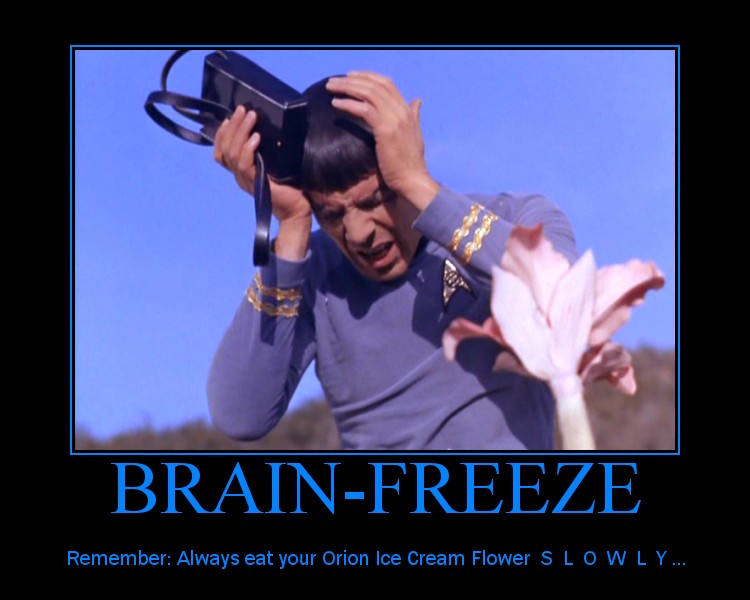
What is, and how to stop, a Brain Freeze


The esteemed British Medical Journal published an editorial on the science behind brain freezes. Good news: you don't have to give up ice cream.

The most common cause of head pain is ice cream - occurring in 1/3rd of a randomly selected population. When something cold touches the roof of your mouth, blood vessels in your head dilate. The dilation may be due to contact with a nerve center in the roof of your mouth.

Whatever the case, if you want to avoid brain freezes don't give up ice cream or cold drinks. Instead, just avoid having anything cold touch the roof of your mouth.

Saturday, July 11, 2009

A Wandering Mind


We all zone out, oftentimes at alarming rates. Discover Magazine recently ran an interesting article arguing that zoning out may not necessarily be a bad thing. Noting that most of the thoughts during zoning out deal with the future and much of deep thought occurs during these periods, Carl Zimmer posits that zoning out allows us to reach goals, but separates them based on their immediacy.

In related news, the Atlantic Monthly ran a feature article some time back entitled "Is Google Making Us Stupid?". Nicholas Carr argues that technological advancements have had a profound impact on how we think. Prior to the typewriter, we had much longer, drawn out sentences, but afterwords writing became much more terse. Today, the age of the internet and hypertext, has redefined 'short attention span' - think blog.