Research suggests the brain actually links hearing with sight because simply seeing a vase shatter activates the brain's auditory areas. In other words, you can "hear" even when you only "see" the sound being produced. MRI scans of silent videos of things being broken or instruments being played revealed activation of the auditory cortex and categorization of the sound.
Showing posts with label vision. Show all posts
Friday, November 11, 2011
Brain Can Hear by Seeing
Research suggests the brain actually links hearing with sight because simply seeing a vase shatter activates the brain's auditory areas. In other words, you can "hear" even when you only "see" the sound being produced. MRI scans of silent videos of things being broken or instruments being played revealed activation of the auditory cortex and categorization of the sound.
Thursday, April 7, 2011
Shoe Thrower Helps Neuroscience
When President Bush ducked shoes thrown at him, Prime Minister Maliki, standing right beside, barely flinched. This confirmed a theory that we have a dual vision system - human brains "see" things far before the eyes.
President Bush ducked because his brain’s action pathway labeled the trajectory of the shoe as a threat well before his perception pathway began to track its flight. Maliki's brain, however, realized the shoe wasn’t headed his way - so he didn't duck.
The findings have implications for sports, among other things.
Labels:
cognition,
dual vision,
eye,
neuroscience,
President Bush,
shoe,
vision
Thursday, March 10, 2011
Video Games Improve Vision
A study suggests that action video gaming can improve one's eyesight.
People who played 5+ hours/week were found to have better contrast vision than non-gamers. Contrast sensitivity is useful for driving at night or in poor visibility ... and the first aspect of vision that deteriorates with age.
Also, non-gamers, who did a daily action video gaming workout boosted their contrast vision that lasted for months. Non-action video games didn’t have the desired effect.
Monday, January 24, 2011
Tennis Referees Handicap
It takes at least .10 second for humans to register an image. With moving objects, we have to construct our perception and the brain requires us to consistently think something has gone slightly further than it really has. It is no surprise then that
research of 4,000+ randomly selected tennis points revealed 83 incorrect calls of which 70 were of the predicted type.
Maybe John did have a point.
Tuesday, November 23, 2010
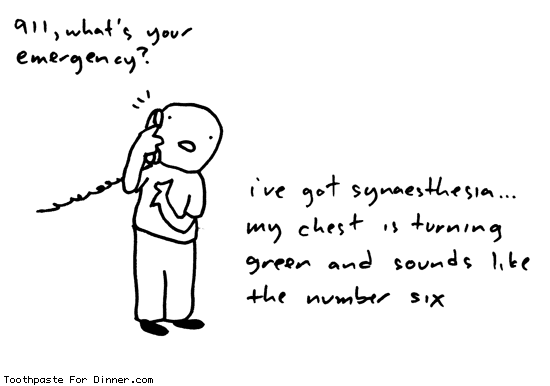
Smelling Sounds, Hearing Colors
Humans can hear colors and smell sounds. Its called synaesthesia and affects ~1 in 1,000 people - most not knowing they have the condition.
"There are people for whom time units evoke colors ... It is also common for a synaesthete to see colors when listening to words, sounds in general or music notes (people who can see music, for instance). There are also cases, although fewer, where people can see colors in flavors, others perceive flavors or experience touch sensations when listening to different sounds, some link flavors to touch sensations, etc."
Tuesday, May 18, 2010
Sea Urchins See With Entire Body
Despite having no eyes, sea urchins can "see". The Journal of Experimental Biology reports that the urchin's entire body cannot only detect light but form images of its surroundings. The way in which the shadow of the urchin's spines falls on the urchin allows them to do so. Researchers posit that the denser the spikes, the better the vision.
Here's a video summary.
Tuesday, November 3, 2009
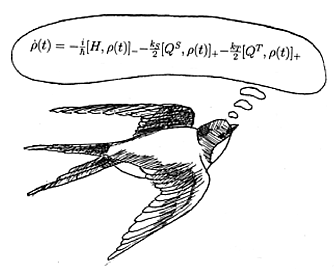
Birds SEE Magnetic Fields When Migrating
Migratory birds have been long known to be able to detect magnetic fields to help navigate their annal routes. The mechanism itself, however, was a mystery. Nature Magazine has published a study revealing that the European robin can actually SEE magnetic fields through the use of proteins situated in the eye's light-sensitive cells! The study also disproved the theory that iron-based cells in the birds’ beaks were the reason for detecting magnetic fields.
Subscribe to:
Posts (Atom)