Showing posts with label social behavior. Show all posts

Monday, September 23, 2013

Wolf Howls for Friends


Research shows that when separated from a pack wolf, the closeness of friendship - not the wolf's rank - dictates the howl's intensity.

Thursday, July 18, 2013

Got Beef? Better Make Sure It Ain't Mutual


Research finds that 3rd parties most likely intervene in fights when drunk men are mutually aggressive, and were more than twice as likely to intervene in a non-aggressive manner. The most frequent aggressive incident (male pursuing a female), or 1-sided aggression between men, triggered few interventions.

Researchers think mutual aggression triggers the most intervention because other research shows that bystanders intervene more when the situation seems more dangerous. But its also possible that avoiding embarrassment compels.


Friday, June 14, 2013

Swearing is ... Good?


Swearing at work, research finds, can build relationships between co-workers and relieve stress. Apparently, swearing, if not intended to degrade, can build solidarity by honestly conveying one's feelings.

Monday, December 10, 2012

Want a Better Job? Get a Simple Name


Research reveals that people with easy to pronounce names have better job and political futures. Attorneys with easier names were promoted quicker and political hopefuls with easier names had better chances of getting elected. Ease of pronunciation, not name length or cultural origin, was the controlling factor.

Sunday, September 16, 2012

For the Kids Sake, Argue with Them


Research finds that youth who were comfortable expressing their opinions at home were better at rejecting peer pressure ... especially teens who used reason to persuade their mothers instead of insults or whining.

Perhaps the independence cultivated at home carries over to school. Those comfortable in relying on their mothers when stressed are less likely to feel dependent on - and less influenced by - friends.

Sunday, August 19, 2012

Sweet Tooth = Sweet Nature


Research finds that people who liked sweet tastes more than savory tastes tended to be kinder. College students answered a survey about their character and also ranked food preferences. Students with a sweet tooth were more likely to volunteer.

Sunday, July 22, 2012

Yawning May Indicate Closeness


Research finds that people are more likely yawn in response to the yawn of someone they know. The "yawn contagion" was highest when responding to family, then friends, then acquaintances, then strangers - the same pattern when measuring empathy in other ways.

Wednesday, June 20, 2012

Don't Gamble with Friends


MRI scans revealed higher activity in the brain's striatum, linked to rewards, when a gambler beat a friend in the lottery vs. when the gambler won alone (the medial prefrontal cortex, linked to social reasoning, showed similar patterns). Victorious group gamblers were also more likely to behave riskier in subsequent lottery trials. In other words, our brain values winning amongst others more than winning alone.

Researchers see an evolutionary correlation as strong incentives exist for high social rank, as dominant animals gain privileged access to limited resources and being alone induces risk-aversion because one bad gamble can be fatal especially without a social network.

Thursday, December 29, 2011

Parks & Public Health


Research finds parks increase physical activity across age groups, thereby helping lower healthcare costs. In a five-city survey, 38% of people over 50 used a park at least 1/week. Other studies showed similar effects on teenage boys and girls. With observable effects with only an increase of $10/person in parks, parks alone can put a dent in the $8,000/year health care costs per person.

Thursday, December 8, 2011

Music = Romance


Research finds that an average-looking man's chances of getting a woman's phone number after flirting doubled when the woman had just heard romantic music.

A guy whom women rated as average talked about food products with ~90 women, aged 18-20. Before the conversation, Group 1 heard a romantic French tune, Je L’aime a Mourir. Group 2 heard a "neutral" French song, L’heure du Thé.

After talking, the guy only 28% of Group 2 women's phone # vs. 52% of Group 1.

Tuesday, November 29, 2011

Baby Babble


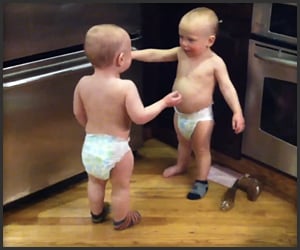
This video of twin babies "talking" has received 55 million+ views. But are they really talking? Probably not.

Babies normally babble by 10 months and use identifiable words by 14 months. Experts say the twins are engaging in “reduplicated babbling,” where they simply repeat a sound without knowing what is really going on.

But they are exhibiting a lot of the characteristics of normal speech (evidently from viewing others around them): taking turns babbling, imitating various speech intonations, emphatically ending sentences or exclamations, using gestures to supplement the babbling and body distance is "very appropriate for most Americans; not too close, but not too far either."

Monday, October 24, 2011

Altruism Takes Time


Research of the survival rates of men, woman and children from the Titanic and the Lusitania revealed that more men survived when the ship sunk fast - i.e. time is controlling.

The Titanic took ~3 hours to sink - survivors were mostly female or children. On the Lusitania, which sank in 18 minutes from a German torpedo, survival of the fittest kicked in and healthy young males mostly survived. Panick controlled the Lusitania while planning and chivalry controlled the Titanic's passengers.

Thursday, September 15, 2011

Teen Driving Restrictions Little Impact


Research shows that deadly car accidents aren't really about driver age but driver experience.

States with strict teenager driving laws wanted to separate novice drivers from dangerous situations. Basically since its inception in 1996, drivers of graduated programs were linked to 1,348 fewer fatal crashes involving 16-year-old drivers but 1,086 more fatal crashes involving 18-year-old drivers.

This means restrictions on driving only limits exposure to risky situations but eventually those kids will have to navigate those situations - and that's where the trouble is born.

Monday, August 8, 2011

Faster = Funner


Instead of "Time flies when you’re having fun," research indicates that when you're having fun, time flies.

In a 10-minute test, “time’s up” was called when only five minutes had passed. The other half worked for 20 minutes before their 10-minute test was done. Results found that the 5 minute team said they had more fun.

Thursday, July 28, 2011

TV & Sex


Research studied the effects of exposure to sexual content on television by genre on adolescents' sex-related views and behaviors. Overall exposure to sexual content was not related to teens' engagement in sexual intercourse the following year. By genre, however, exposure to sexual content in comedies increased chances of sex the next year and sexual content in dramas had a negative effect.

Distrust Increases Creativity


It would seem that distrust and creativity are incompatible. When you are distrustful, you are less likely to share information, something crucial for creativity to emerge in social settings.

Research, however, reveals that distrust seems to foster thinking about non-obvious alternatives to potentially deceptive outcomes, i.e. distrust may foster creativity. While distrust harmed public creativity, distrust enhanced private creativity and researchers feel enhanced cognitive flexibility is the mechanism by which this occurs.

Saturday, July 9, 2011

Clean Smell Promotes Morality


A study finds that people sprayed with citrus-scented cleanser were fairer and more generous than otherwise. Scientists first evaluated fairness and discovered clean-smelling room subjects offered twice as much cash with a stranger in another room. In the second test, clean-smelling room participants were significantly more interested in volunteering and almost three times more likely to donate money.

Katie Liljenquist, lead author of the study, notes, "There is a strong link between moral and physical purity that people associate at a core level."

Tuesday, July 5, 2011

Parents Regularly Lie to Kids


Research finds that to influence behavior, parents regularly lie to children - even those who stress speaking the truth. Compared to European American parents, Asian American parents held a more favourable view of lying to children for behavior modification.

Saturday, June 25, 2011

Politics Still Struggles with Color


Yale researchers mailed letters to legislators with fictional names, asking for help in registering to vote. Some letters were signed with "black" names (e.g. DeShawn Jackson) and some with "white" names (e.g. Jake Mueller). Findings reveal that letters from "black" constituents received fewer responses from white legislators and received more responses from minority legislators. Also, the behavior crossed party lines. Whites from both parties behaved similarly - even when the letters indicated the constituent's party lines.

Wednesday, June 8, 2011

Family vs. Politics


A study reveals an inverse relationship between family ties and political participation. The more people rely on the family to provide services, insurance, and resources, the lower one's political participation and civic engagement. Strong family ties are a substitute for generalized trust, instead of a complement to trust.

Something to consider next time the far right espouses family values in their campaigns.